Your assets warn you before they fail. We see it in time.
We interpret the real condition of your equipment and define the right intervention while there is still time to choose when to do it. Using the data your plant already generates, with a specialist behind every alert.

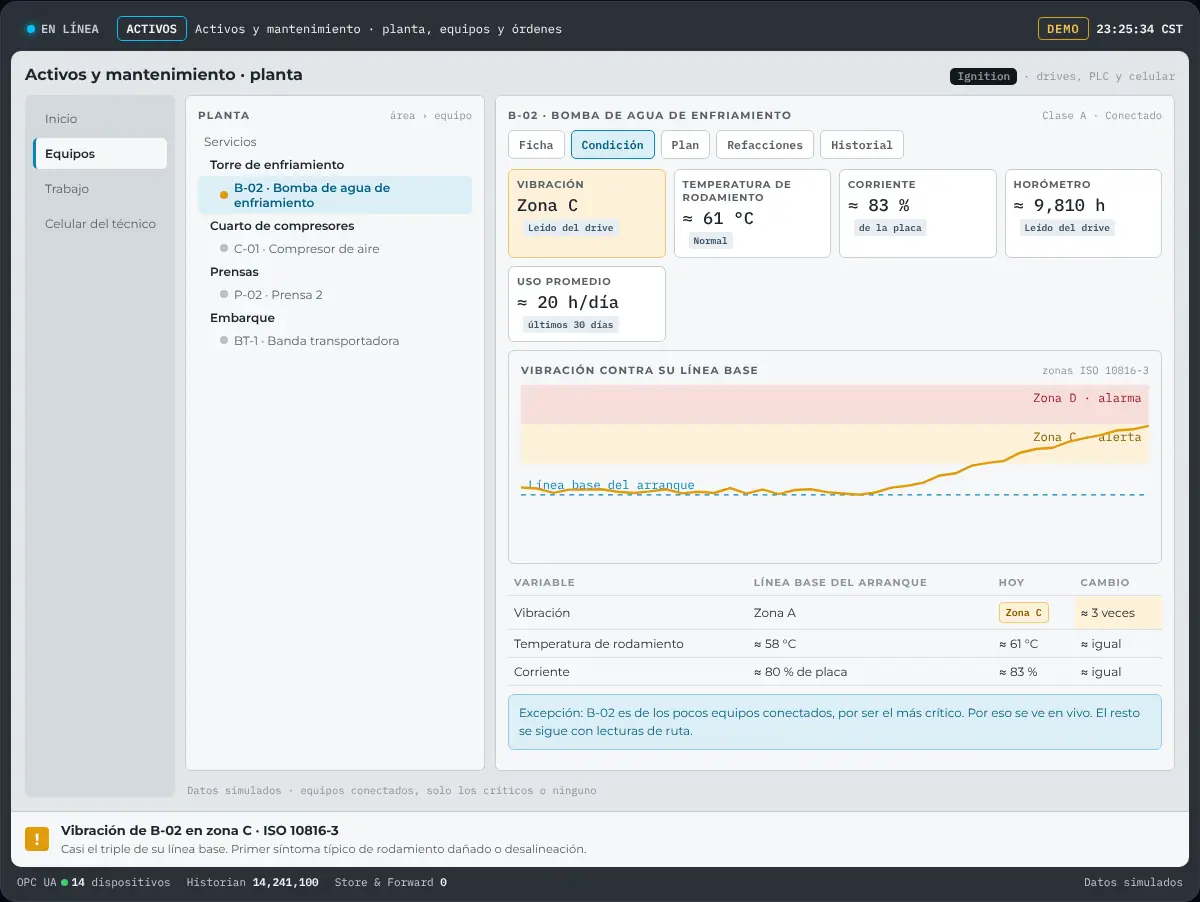
Interactive replica with simulated data. You can try it in the demo room.
No failure appears out of nowhere
Every asset gives warning before it stops. The problem is not that machines fail: it is finding out when there is no margin left to decide.
From understanding the asset to returning it to production
The program is not a system you install: it is a way of managing the asset, and it always moves in the same order.
Understand
Before measuring anything, know what you are looking at and why it matters.
- Know the asset and what happens downstream if it stops
- Understand the process: real loads, cycles and starts
- Leverage what is already measured in the plant
- Add only where it contributes to the decision
Interpret
Data alone says nothing. The value lies in reading it in context.
- Visualize the condition at a glance
- Distinguish a normal variation from real degradation
- Validate in the field with your team before dispatching anyone
Act
Information is only useful if it ends in a decision and an intervention.
- Intervene in the window that suits production
- Verify with data that the asset returned to its normal behavior
- Keep monitoring with a richer history
The program does not start by installing sensors
It starts by understanding what information your plant already generates. In most operations there is very valuable information that no one uses because it is scattered across systems that don't talk to each other.
Understand first. Then complement, only where measurement changes a decision. Over-instrumenting makes the program more expensive and does not improve the diagnosis.
Everything converges on a single platform built on Ignition: real drive hours, a run signal or route readings corrected in the field. All equipment connected, only the critical ones, or none.
This is how your asset condition looks
What is happening now, what had been happening and what is best to do about it, in one place. These screens are part of the demo you can try in the demo room.
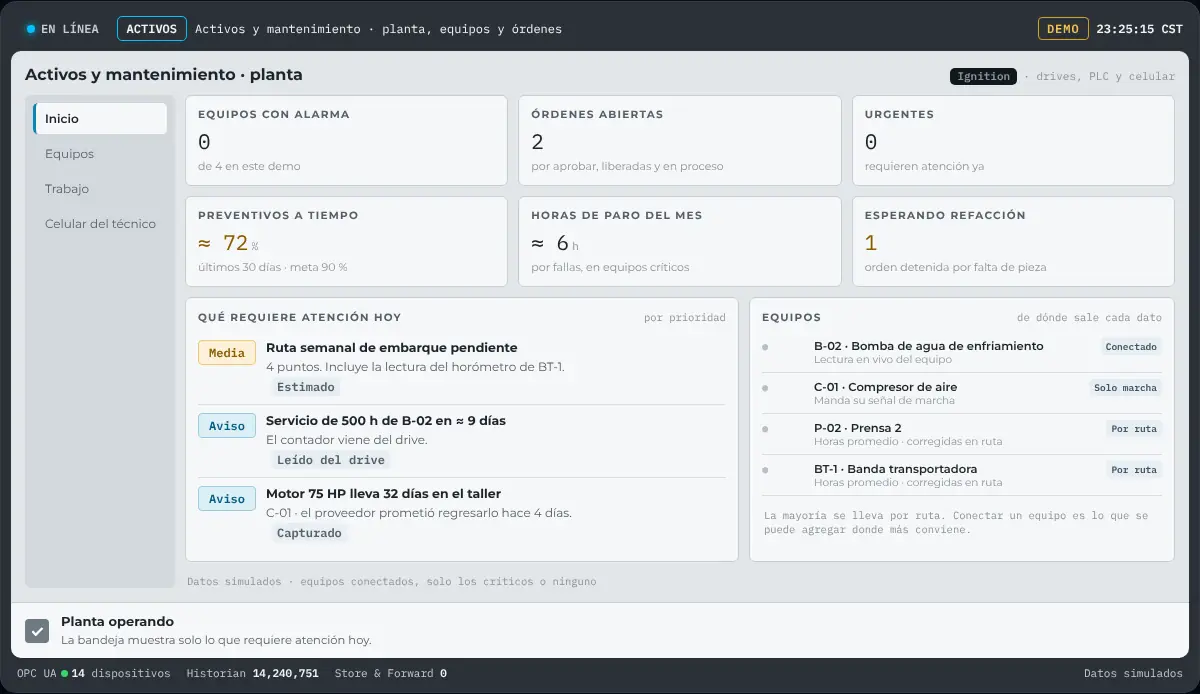
What needs attention today
The inbox brings together everything pending in order of priority: equipment in alarm, open work orders, preventive tasks on time, downtime hours and equipment waiting for spare parts.
The work order is triggered by what the equipment measures
Each piece of equipment compares its vibration, temperature and current against its own baseline. When the pattern changes, the probable cause and the predictive work order appear, before the shutdown.
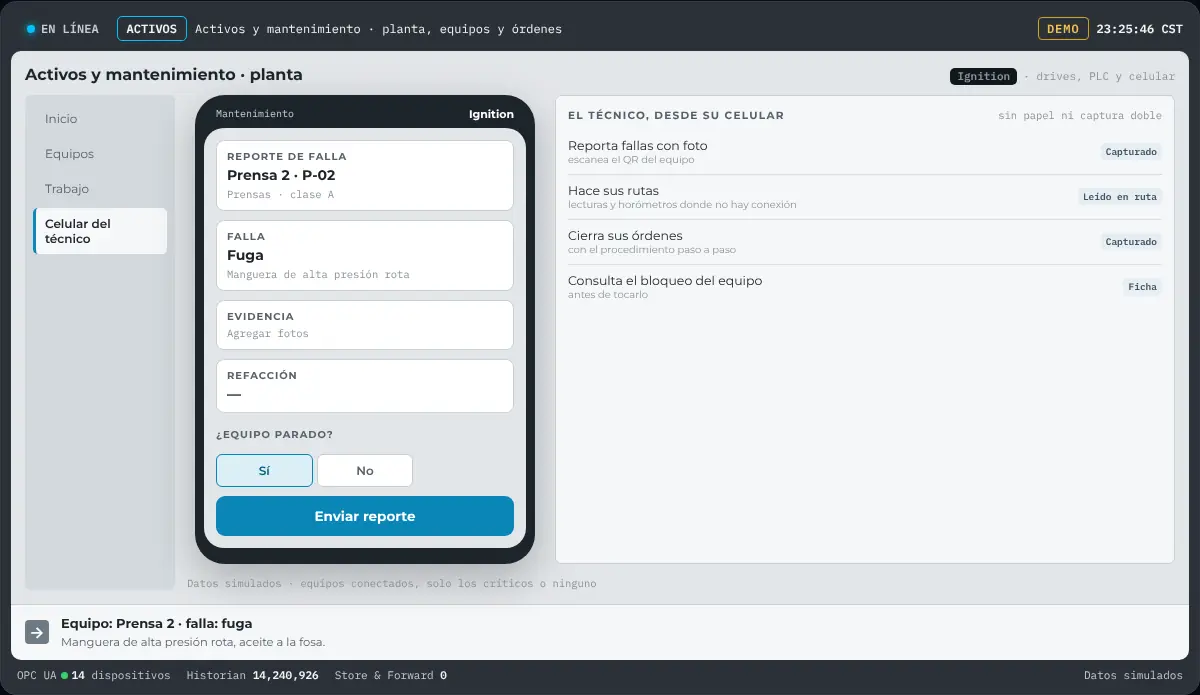
Corrective work documented from the floor
The technician reports with a photo from their phone, runs their routes with an hour meter and checks the procedure before touching the equipment. Nothing is entered twice.
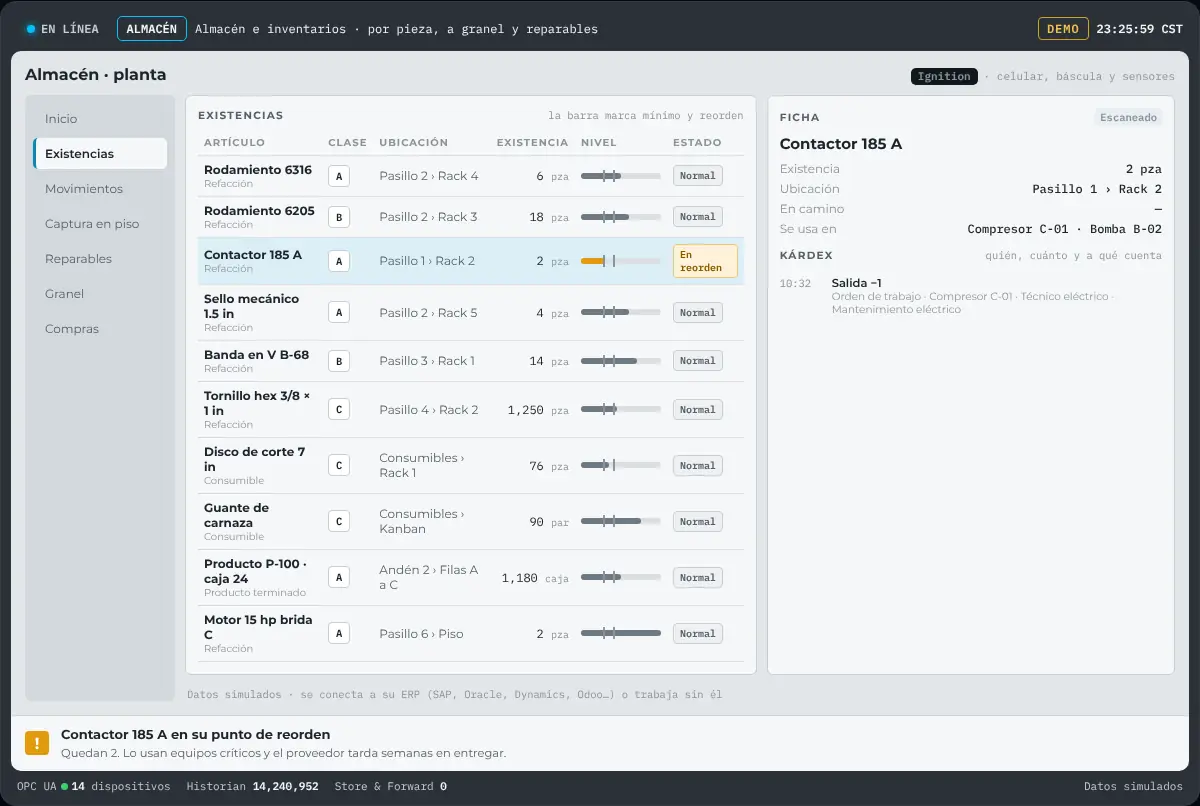
And the spare part is already reserved
The program connects with the storeroom: it knows whether the spare part is in stock before stopping the equipment, reserves it when the work order is released and, if a critical part reaches its reorder point, the requisition goes out automatically.
We don't come to investigate. We come to confirm.
When a condition worth attention appears, the specialist who arrives at your plant has already studied the case. The visit is not spent gathering information: it is spent confirming the diagnosis and deciding the best strategy with your team.
- The history of the asset
- Its usual behavior and recorded trends
- The evolution of the variables and the operating context
- The probable cause of the problem
And the technical response is already in-house
Once the condition is validated, the program activates the capabilities of the Industrial Maintenance Division:
- Specialized maintenance
- Repair of industrial electronic equipment
- Industrial rigging
- Industrial spare parts
- Commissioning
- Specialized equipment and consumables
Every asset warns in its own way
A motor does not degrade like a transformer, nor a pump like material handling equipment. The program adapts to the failure mode of each equipment type.
Material handling
Their stoppage blocks the entire building.
Pumps
Continuous operation with progressive degradation.
Electric motors
The most common asset and the one that warns the most before failing.
Variable frequency drives
Electronics sensitive to temperature and duty cycle.
Compressors
An auxiliary service that entire lines depend on.
Transformers
Long life, silent degradation.
Heat treatment
Severe operation, high temperature and demanding cycles.
Special equipment
Unique assets that no standard program covers.
Results, not dashboards
Higher availability
The asset spends more hours producing and less time waiting for repair.
Fewer unplanned shutdowns
The failure is addressed in a chosen window, not in an emergency.
Condition-based maintenance
You intervene on the equipment that needs it, when it needs it.
Better planning
Spare parts, personnel and windows prepared in advance.
Longer service life
Correcting in time prevents a minor deviation from damaging the whole assembly.
History per equipment
Each asset builds its own technical memory.
Well-founded decisions
Each intervention is justified with information, not intuition.
Better use of personnel
Your team spends its hours on what actually changes the result.
Which asset keeps you up at night?
You don't need data or instrumentation. Tell us which equipment worries you and why, and together we will review what can be known today about its condition.